
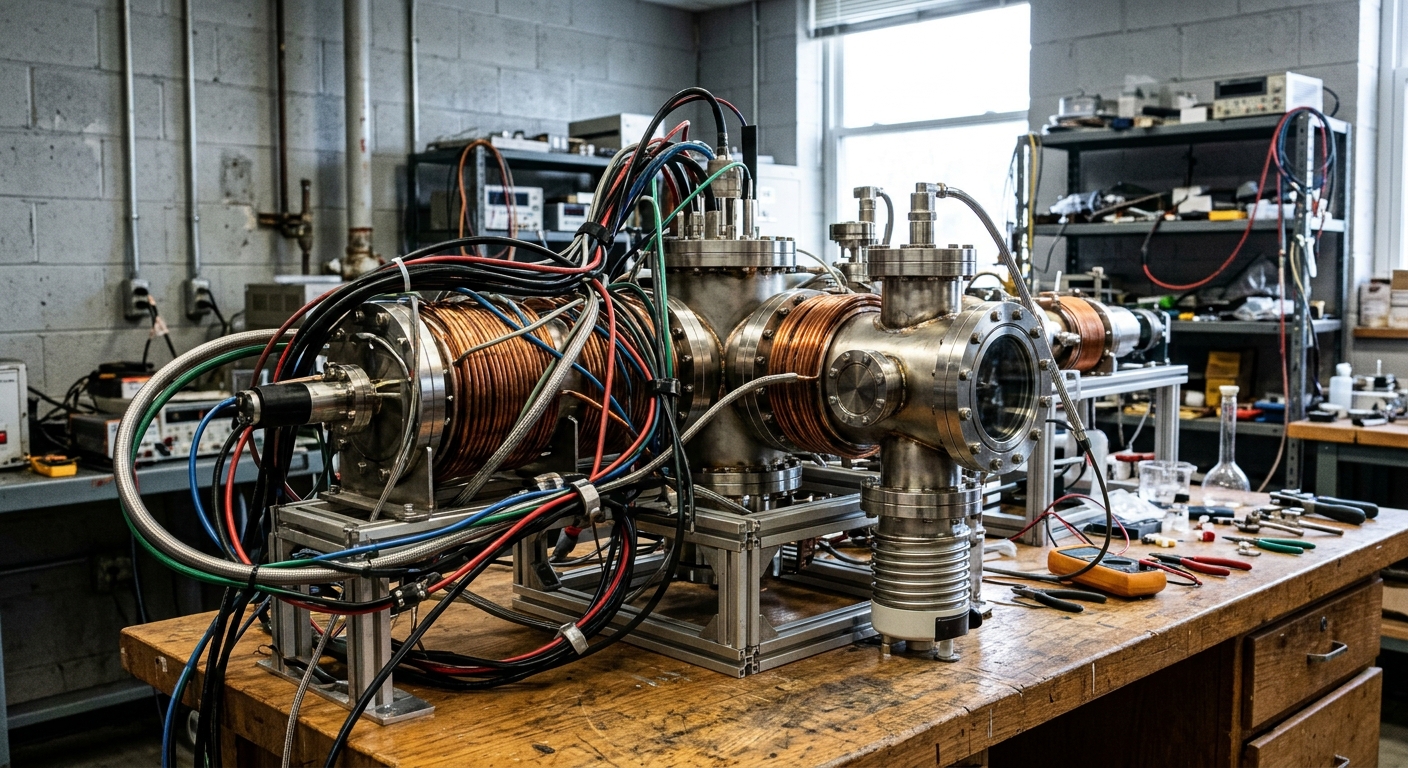
AI-generated illustration; not a photograph of the reported event.
- calendar_today October 30, 2026
Breakthrough in Antimatter Research
Physicists at Northwestern University have successfully trapped a single positron, a type of antimatter particle, for months in their laboratory. This achievement marks a significant milestone for fundamental physics and could potentially challenge long-standing theories about the formation of our universe.
How the Experiment Worked
The research team, led by Gerald Gabrielse, director of Northwestern’s Center for Fundamental Physics, managed to capture the notoriously elusive positron using a specialized setup. By deploying electric and magnetic fields, they created what Gabrielse described as a container "without walls." This setup, which uses a combination of batteries and magnets, enabled them to freeze the positron in a resting state, preventing it from annihilating upon contact with matter. The device is called a “one-positron quantum cyclotron.”
Studying Antimatter in a Quantum State
The ability to trap and store a positron for an extended period allowed the physicists to study the antimatter particle’s properties in a controlled quantum state. "This allowed us to observe the positron, its energy levels and take really precise measurements," Gabrielse said. Their experiment and its results were published in the journal Physical Review Letters earlier this month.
Implications for the Standard Model
The findings have profound implications for particle physics. According to the Standard Model, positrons and electrons should be perfect mirror images of each other, with identical properties apart from opposite electric charges. Precise measurements of a positron’s magnetic properties can now be compared directly with those of an electron. If differences are found, it could “poke a hole in the Standard Model,” Gabrielse explained, adding that this may help explain why the universe contains so much more matter than antimatter—a central mystery in cosmology.
Investigating the Origins of the Universe
Gabrielse noted that, according to currently accepted theories, the Big Bang should have created equal amounts of matter and antimatter, which would annihilate each other, potentially leaving nothing behind. “There’s clearly something wrong with that theory, and that’s what we’re trying to figure out,” he said. The team’s ongoing investigations could help address this discrepancy and contribute greatly to our understanding of why our universe is made, predominantly, of matter.
Beyond Basic Science
In addition to its significance for fundamental questions about the universe, Gabrielse suggested that the ability to control and study antimatter particles could also lead to new technologies. “Experiments like this are motivation to try to get a better way to describe our universe,” he said, underlining the potential broader impacts of the research.
Source: chicago.suntimes.com.


