- calendar_today August 16, 2025
.
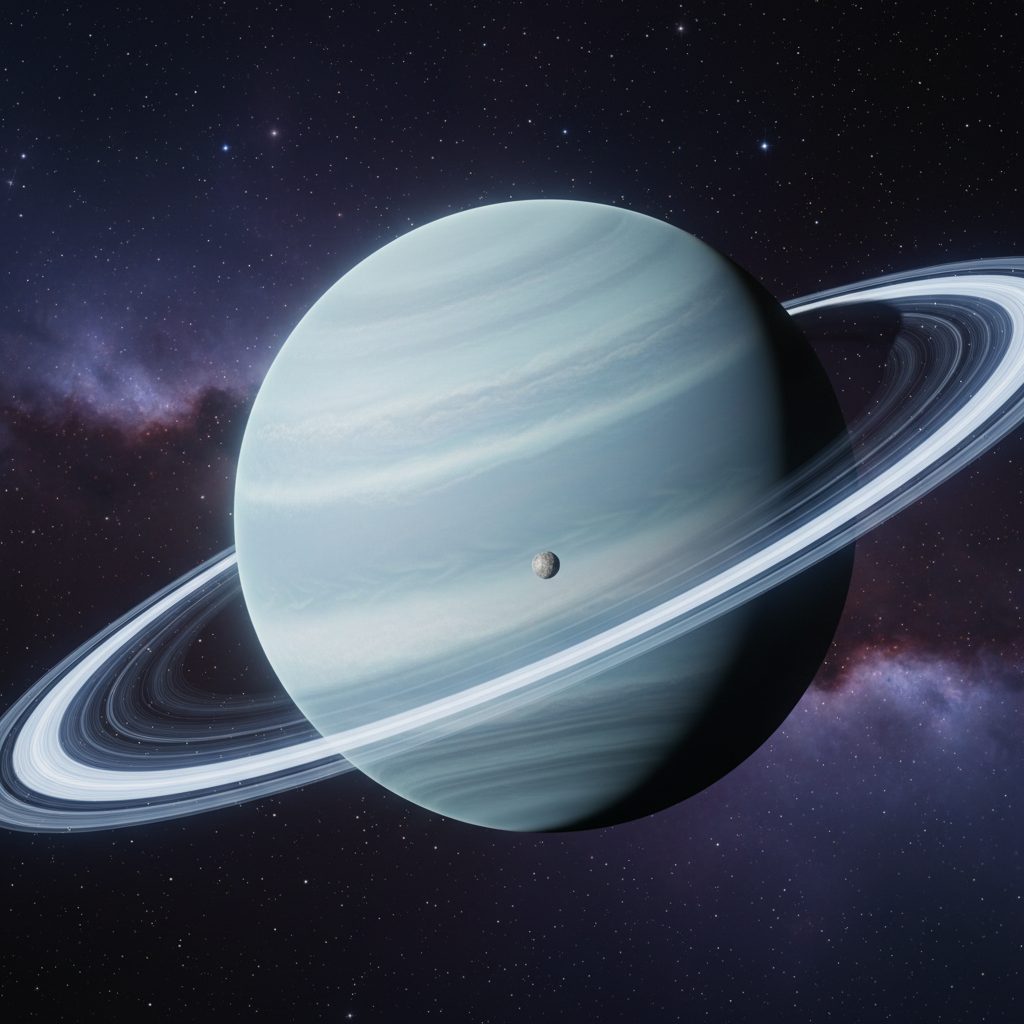
NASA’s James Webb Space Telescope (JWST) has helped astronomers discover a new moon orbiting Uranus. The previously hidden satellite is one of the planet’s 29 known moons. Astronomers say the ringed ice giant, which rotates on its side in the solar system, may still have several other moons waiting to be found.
Webb revealed the new moon on Feb. 2 with a series of long-exposure 40-minute images. The moon is just 6 miles (10 kilometers) in diameter, making it one of the tiniest natural satellites yet found around Uranus. “This is a small moon but a significant discovery,” said Southwest Research Institute scientist Maryame El Moutamid, a lead investigator for the find. The small body, provisionally named S/2025 U1, is visible here orbiting Uranus.
Webb’s Near-Infrared Camera captured the new moon’s images. The moon’s small size and the bright rings of Uranus likely hid it from previous spacecraft and telescopes. Even NASA’s Voyager 2 spacecraft, which visited Uranus on its grand tour of the solar system nearly 40 years ago, missed it.
“The discovery shows how Webb is extending the frontier of knowledge built by previous missions by leaps and bounds,” El Moutamid said in a statement. She’s also the principal investigator of a Webb program that’s exploring Uranus’ rings and inner moons. “Webb’s ability to detect faint infrared light allowed us to finally spot it.”
The new moon’s discoverers reported their results in a paper submitted to The Astrophysical Journal. It’s available in preprint form on arXiv.
James Webb Space Telescope moon discovery: This discovery of a new moon around Uranus is significant because the planet’s moons may give clues about how its unusual ring system formed. Scientists now know of 29 moons around Uranus, and we may find more.
Inside Uranus’ Rings, Weather and Atmosphere
The newly spotted moon S/2025 U1 is about 35,000 miles (56,000 kilometers) from Uranus’ center. It’s in a nearly circular orbit that lies in Uranus’ equatorial plane. The moon orbits between two other known moons, Ophelia just beyond Uranus’ main ring system, and Bianca. It’s in about the same orbital plane as those two other satellites. Its orbit indicates that it likely formed near its current location.
Astronomers had trouble separating the moon from Uranus and its bright rings. The small satellite is dark, so tiny, and moves so quickly across the sky that it was difficult to spot in the bright glare. The new Webb observations build on a record of Uranus’ rings, weather, and atmosphere glimpsed since the telescope launched in 2021.
Unlock the Mysteries of Uranus’ Rings and Moons
There are two big mysteries of this discovery. The first is the origin of the planet’s ring system. Scientists think the newly spotted S/2025 U1 moon and parts of Uranus’ rings could share a common origin. The second mystery is how many other such small moons might still be hiding around Uranus.
“There are no other inner moons in our solar system clustered as close to each other as these are,” El Moutamid said. Their orbits should intersect and scatter, but they remain locked in place, which is a mystery. Astronomers believe these moons may shepherd Uranus’ narrow rings.
One outside astronomer who was not part of the study but who discovered a moon around Uranus in 2024 praised the new work. “The discovery of this new Uranian moon by the James Webb Space Telescope is very exciting. It’s a very small object, and its proximity to the inner ring system of Uranus makes it particularly important,” Scott Sheppard of the Carnegie Institution for Science said in a statement.
The SETI Institute’s Matthew Tiscareno is the other co-principal investigator of the Webb Uranus project. He added that this discovery “once again shows how blurred the line between Uranus’ moons and its rings really is. Their complex inter-relationships hint at a chaotic history. As the smallest and faintest of Uranus’ known inner moons, it also suggests there must be more satellites waiting to be found.”
Before Voyager 2, only five moons of Uranus had been observed since their discovery as far back as 1787. Voyager 2 discovered 10 more, each with a diameter between 16 and 96 miles (26 and 154 kilometers) in diameter. Ground-based telescopes and the Hubble Space Telescope later discovered 13 additional small moons. These are each just 8 to 10 miles (12 to 16 kilometers) across, and they are dark, even darker than asphalt. Inner moons are made of a mixture of ice and rock, while outer moons beyond Oberon are suspected to be captured asteroids.
Looking ahead, NASA and scientists could return to Uranus soon. A planetary decadal survey by the National Academies of Sciences, Engineering, and Medicine, which was released in 202,2, named a Uranus Orbiter and Probe mission as NASA’s next large planetary science endeavor. It could launch in the early 2030s if it gets funding in an environment of contentious budget battles in Congress. It would study Uranus’ tilted axis of rotation, complex magnetic field, weather patterns and atmospheric dynamics, and icy ocean worlds, which it might harbor on its moons.
Moons as small as a few kilometers across are likely waiting to be found, Sheppard thinks. They may be detectable with more long-exposure Webb images or with a future spacecraft. “We’re going to continue refining the orbit of this newly discovered moon and try to find more hidden satellites around Uranus with Webb,” El Moutamid said.