- calendar_today August 20, 2025
.
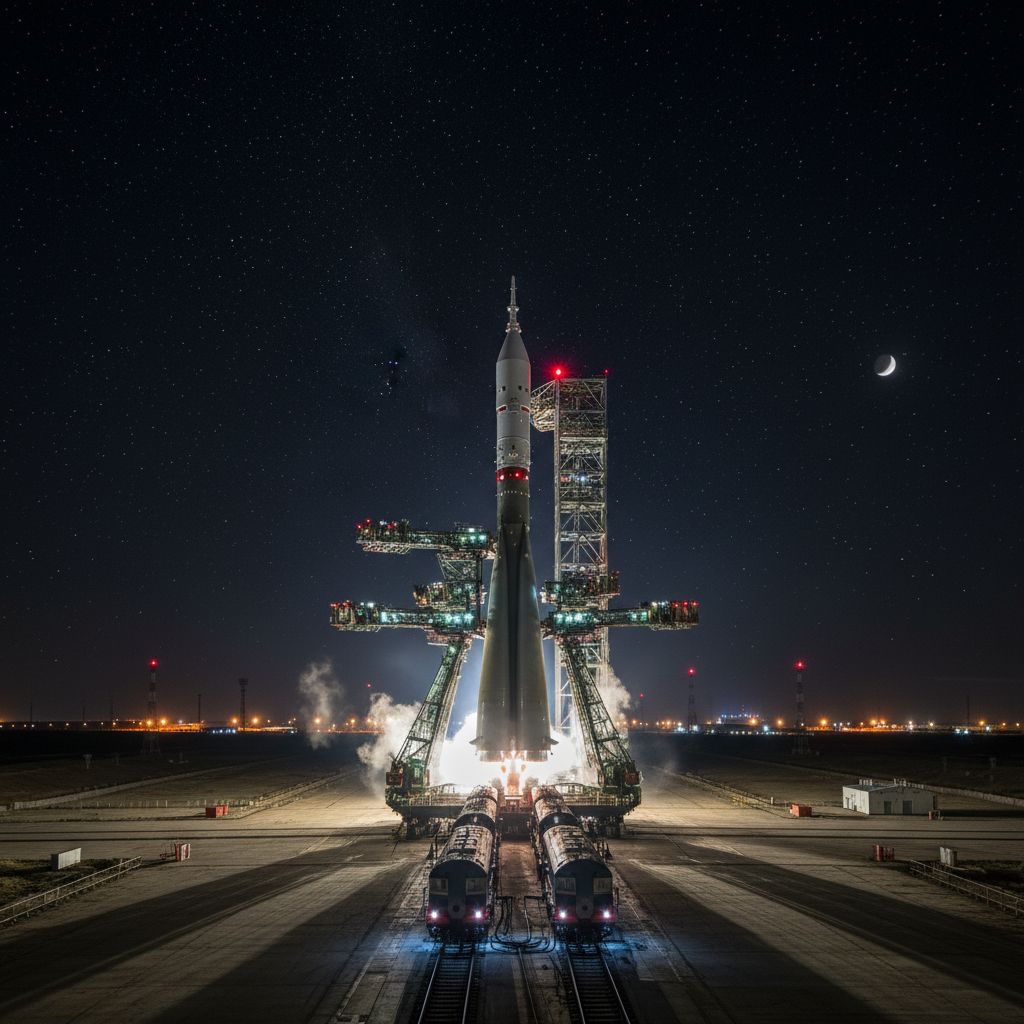
Russia is close to readying the latest version of its Soyuz rocket, Soyuz-5, for its first test flight by the end of this year. Dmitry Bakanov, the head of the Russian space agency Roscosmos, told the state news service TASS in an interview that the flight could take place this December.
“Yes, in December. Everything is ready,” Bakanov stated.
The Soyuz-5 was to be launched from the Baikonur cosmodrome in Kazakhstan. If it does fly in December, it would mark the first flight of a Soyuz rocket in over a decade. Development has taken a long time, but Roscosmos says it could need several test flights before entering service in 2028 or later.
Legacy Design
The Soyuz-5, also known as Irtysh, is not a groundbreaking design. Roscosmos has instead based it on older Soviet-era work, drawing engineers to the project in 2016. The key innovation in the Soyuz-5 is that its production has been brought entirely within Russia.
The change is not a minor one, as Russian has long been dependent on Ukraine for parts for its rockets. One case in point is the Zenit-2, a launcher developed in the 1980s by Ukraine’s Yuzhnoye Design Bureau in Dnipro and flying missions into the 2010s. While the first and second stages were Ukrainian-built, the main engine—the RD-171, made by NPO Energomash—came from Russia.
The two countries worked on Zenit together even after the Soviet Union broke up in 1991. The relationship finally ended with Russia’s full-scale invasion of Ukraine in 2022. In late 2023, Russia destroyed the factory in Dnipro that had once produced Zenit rockets.
The Soyuz-5 is a larger, homegrown version of Zenit. If its development continues to go well, it will end Russia’s long reliance on Ukrainian-supplied rocket parts.
The Rocket
Soyuz-5 is a medium-lift launch vehicle capable of delivering a payload of about 17 metric tons to low-Earth orbit. It is slightly larger than the Zenit-2 and features larger fuel tanks for more lift.
The most notable component in the rocket is the RD-171MV engine. This new version is based on the technology that powered Soviet Union’s Energia space launch system in the 1980s, a rocket that also once lofted the Buran space shuttle. The RD-171MV is a successor to the RD-171 that powers the Zenit.
Unlike previous versions, this engine has no Ukrainian-made components. The RD-171MV uses a combination of kerosene and liquid oxygen as propellants. In terms of power, the new engine is the most powerful liquid-fueled rocket engine in the world. It can produce more than triple the thrust of a Space Shuttle main engine.
Soyuz-5 is not reusable like many of its competitors, including SpaceX’s Falcon 9. That might put the launcher at a disadvantage when it comes to long-term competition.
Soyuz-5 and Russia
Roscosmos aims to use Soyuz-5 as a replacement for both the Zenit and the much older Proton-M rocket. It provides a way for Russia to end its reliance on these old Soviet designs as well as on Ukraine for production.
Russia’s space program has seen budget cuts in recent years as the government has poured money into the war in Ukraine. Still, the program has been able to develop Soyuz-5 at a pace that allows a test flight this year.
Russia analysts see Soyuz-5 as a stopgap solution. It will let Russia’s space program limp along, but it is not a major leap forward. For that, Moscow would have to look to a different project, Soyuz-7. Also called the Amur project, it is supposed to have a reusable first stage and methane-fueled engines. If successful, the new rocket could challenge existing designs.
At the moment, the Amur project appears to be on ice, with no clear schedule for when it will fly. The original first flight target was 2027, but delays have pushed that out. Industry experts now do not see the rocket flying before 2030. Soyuz-5 will likely be needed for several more years.
Commercial Aspects
Will Russia be able to find commercial buyers for Soyuz-5? Russia is a small player in a global launch market now dominated by SpaceX and, increasingly, China. Their reusable rockets and competitive pricing make it difficult for anyone else to make a go of business.
Russia’s current crewed launch vehicle is Soyuz-2, and for heavy payloads, it still uses the Angara. Neither has done well at luring foreign customers, and Roscosmos will need Soyuz-5 to prove its value in order to do better. Can the Russian space agency do it, when the world’s leading providers have an advantage in experience and resources? That remains to be seen.
Final Thoughts
It will be interesting to see how the upcoming Soyuz-5 test flight goes. If it is a success this December, it will show that Russia still has the capability to produce new space hardware, despite the sanctions and tight budgets of recent years.
The new rocket may not be cutting edge. But for Roscosmos, it provides much-needed independence as well as continuity, perhaps even a lifeline to survive in a very difficult time.