- calendar_today August 15, 2025
H.R. Giger’s Forgotten Monster: Revisiting Species
It was announced earlier this month that Hollywood icon Michael Madsen, best known for hard-boiled roles in Reservoir Dogs, Kill Bill, and Donnie Brasco, had died. Fans may know Madsen’s diverse filmography, from acting to producing to directing, but one of his more esoteric projects is rarely called back to in most filmographies. A supporting role as a black ops specialist tracking down a human/alien hybrid in the 1995 sci-fi film Species is one of the more recent relics from Madsen’s past, one that both gave and benefited from the profusion of monster and alien invasion flicks of the 1990s.
Species is a brainchild of screenwriter John Wooley and director Roger Donaldson, who, between them, had experience in everything from sci-fi (Strange Invaders) to thrillers (No Way Out) to period drama (The Bounty). Species combines parts of each of those elements into a strange, intriguing stew of alien horror. At the start of the film, the U.S. government picks up two transmissions from outer space. One, encoded in a highly advanced language, details a revolutionary new fuel source. The other transmits an exact formula to splice alien DNA with human DNA. The government, of course, wastes no time in doing this. Supervised by Dr. Xavier Fitch (Ben Kingsley), the resulting hybrid is a female named Sil, played in her formative years by Michelle Williams. Fitch was attempting to produce a new, controllable species of organism, but things didn’t go as planned.
Sil rapidly matures, aging in only three months to the body of a 12-year-old. But there are strange things about her: she has violent nightmares, and there are indications that her ability to be “controlled” isn’t going to be as easy as Fitch might have hoped. When he orders cyanide pumped into Sil’s cell in an attempt to abort the experiment, she fights her way out and escapes.
In order to find her, Fitch calls together a team of specialists to round her up. This includes Madsen’s Preston Lennox, a taciturn black ops mercenary; molecular biologist Dr. Laura Baker (Marg Helgenberger); anthropologist Dr. Stephen Arden (Alfred Molina); and a brooding empath named Dan Smithson (Forest Whitaker), who can access the emotions Sil is experiencing. Tracking her across the U.S., the team eventually catches up to her in Los Angeles, where Sil, now fully matured and played by Natasha Henstridge, starts on the path to maturation by seeking out and killing potential mates to breed and propagate her species. She’s intelligent, resourceful, and ferociously instinctual. Bodies pile up: a train tramp, a barroom victim, a man who is killed while sleeping with her. The chase is on to stop her before her children become just as prolific.
A Killing Beauty
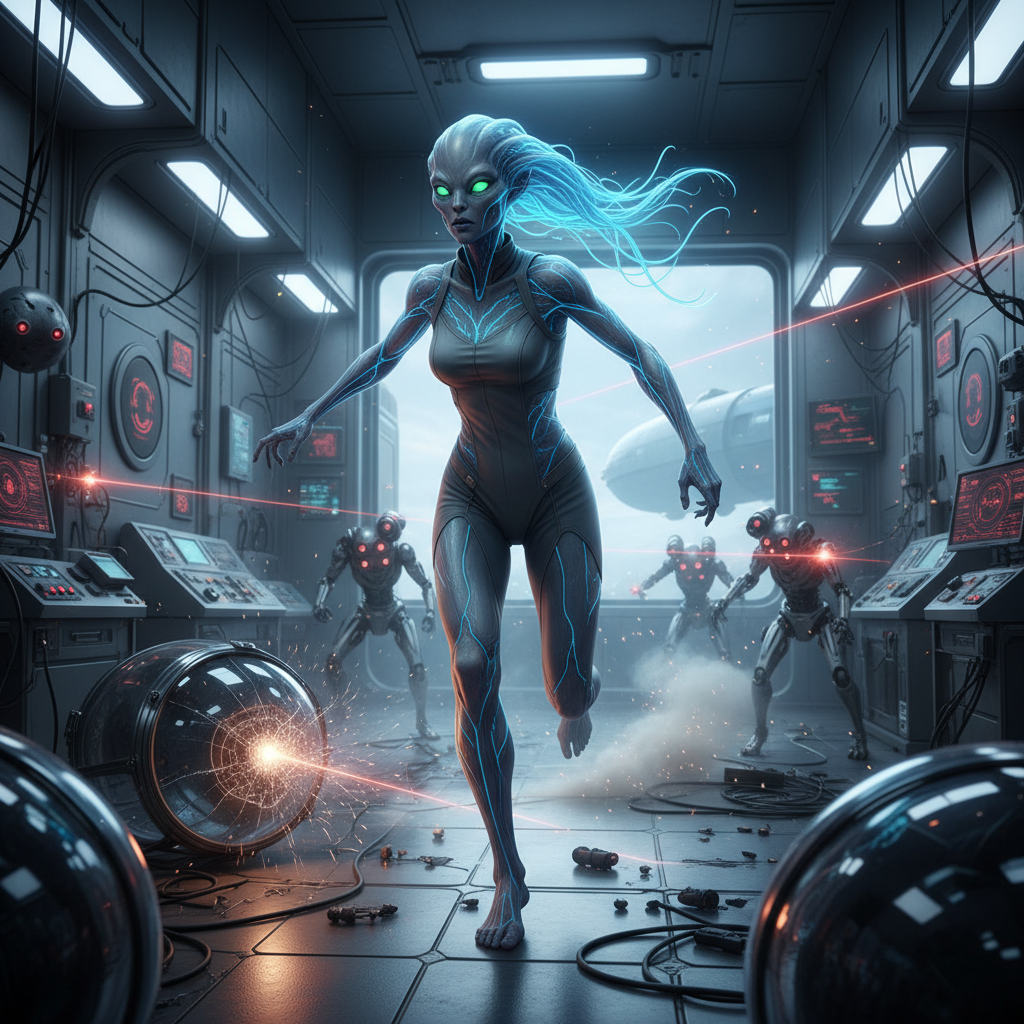
What set Species apart was the creation of its otherworldly protagonist. Legendary surrealist artist H.R. Giger was brought on to design Sil; Giger, most famous for his work on Alien, was known for seamlessly blending soft science fiction with his erotic horror. For Species, Giger intended to produce something he described as “an aesthetic warrior, also sensual and deadly.” Giger’s design was immediately recognizable and distinctive; Species‘ Sil’s final form was to be a woman with translucent skin, described in the effects notes as “an X-ray; like a glass body but with carbon inside it.” Giger had envisioned multiple stages of Sil’s alien evolution for the final film, but budget and production considerations left only a transformation cocoon for Sil’s maturation and a full alien body for the final confrontation.
Species was a commercial success, but Giger did not appreciate the final film. He held the opinion that Species had too many similarities to his earlier Alien work, including the “punching tongue” and the infamous birth scene near the end, which he saw as cribbing heavily from the chestburster in Alien. Giger had to step in to ensure that Sil was killed by a bullet to the head near the climax rather than by flame throwers. In Giger’s opinion, the latter was too similar to similar endings in Alien 3 and Terminator 2.
Species was neither a critical nor a commercial masterpiece. The dialogue was clunky, the characters were flat, and the themes—bioethics, first contact, motherhood, sexuality—were hinted at but never fully realized. Kingsley’s Fitch was an unconvincing cipher, and Whitaker’s empathetic character did little but hang around the fringes muttering the obvious. Nevertheless, there is a weird sort of charm to Species‘ mishmash of soft sci-fi and body horror. Screenwriter Feldman based the central premise of the film on a little-known but influential article by science fiction author Arthur C. Clarke, which mused that aliens would likely never make it to Earth because of the improbability of faster-than-light speed technology. What if, Feldman wondered, an alien species reached out to Earth with the instructions for building a hyper-intelligent, sentient lifeform using only Earthling DNA?
The result was a film that could double as both creature feature and cautionary tale, and which has won its cult following in the years since its release. While it will never stand alongside Alien or Terminator or even its contemporaries like DeepStar Six or The Langoliers, Species has its charms, from Henstridge’s captivating performance as Sil to Madsen’s grizzled machismo to Giger’s still-distinctive design work. It is a curiosity of a ’90s sci-fi blockbuster, and it deserves revisiting—even as we look back on the storied career of Michael Madsen.