- calendar_today August 18, 2025
Nvidia, renowned for its AI-accelerating graphics cards that have become incredibly valuable, is now exploring an innovative use for this power: Nvidia incorporates artificial intelligence directly into the gaming experience.
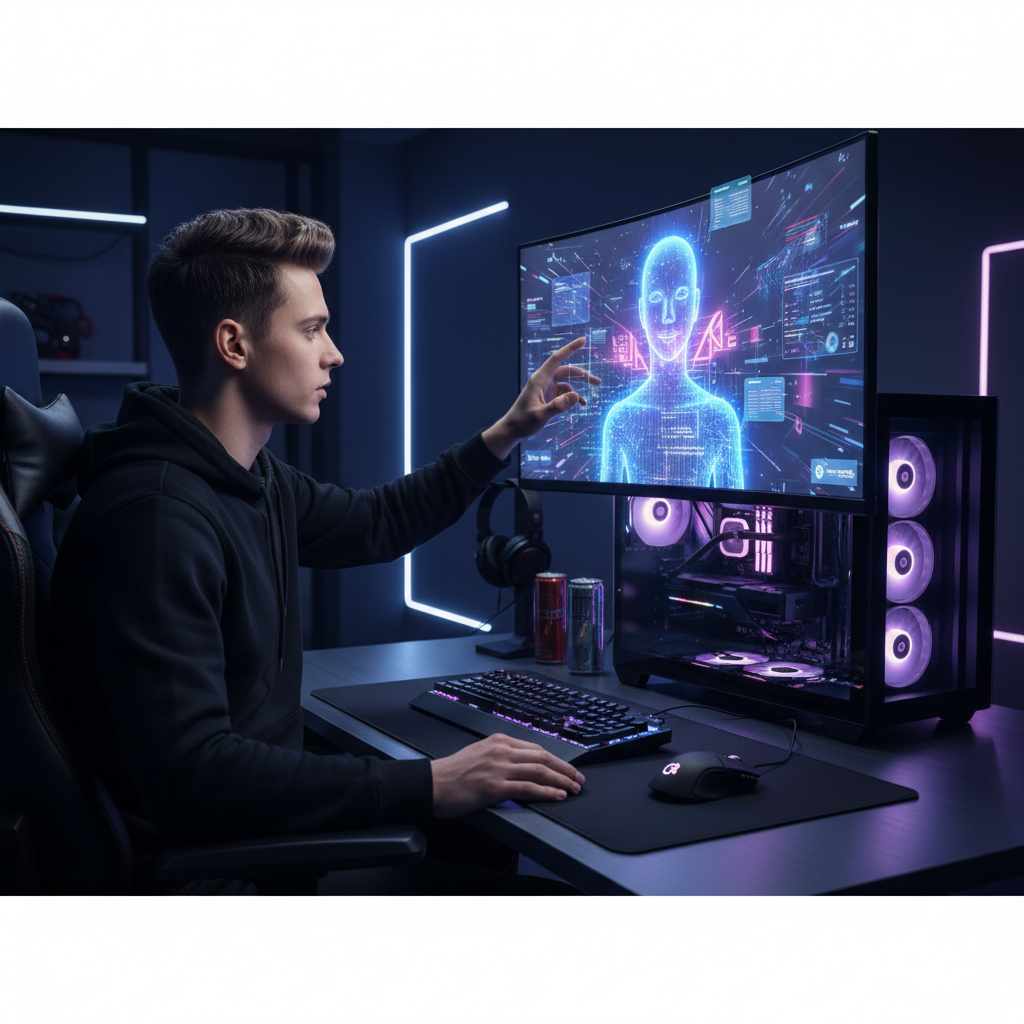
The GeForce RTX GPUs mainly serve immersive gaming purposes for users, but Nvidia has unveiled its experimental G-Assist AI, which operates locally to improve computer optimization and gaming performance. This ambitious project provides an overlay accessible through the Nvidia desktop application, which allows users to interact with an AI assistant via text or voice commands to monitor system stats and adjust settings.
G-Assist presents a collection of captivating capabilities. Through this system, users have the ability to ask broad questions like “Explain how DLSS Frame Generation works” to acquire detailed responses. The AI achieves management of certain system-level settings. Gamers who activate G-Assist receive real-time system performance analysis along with automatically created data visualizations. Players can command the AI to change system settings specific to individual games or turn features on and off. G-Assist enables users to boost their performance by providing GPU overclocking capabilities and projecting performance enhancements.
The public release displays interesting features but fails to reach the deep integration level shown in earlier previews. G-Assist’s starting idea centered around game awareness to deliver context-sensitive recommendations for players to reach their in-game targets. At present, only a limited number of games offer this level of integration with Ark: Survival Evolved as a primary example.
Bridging the Gap: Peripheral Integration and Performance Trade-offs
Nvidia expanded its system capabilities by incorporating support for external plug-ins from third-party developers. The G-Assist application can interface with hardware products from prominent brands, including Logitech G, Corsair, MSI, and Nanoleaf. Game developers now can instruct MSI motherboards to adjust thermal management settings or program Logitech G devices to change LED lighting according to system conditions or gameplay events.
Nvidia wants to demonstrate desktop systems with dedicated GPUs as inherently capable for AI processing while the PC market witnesses a wave of “AI laptops.” Nvidia launched the versatile ChatRTX application earlier in the market while current AI tools are predominantly based on cloud systems. Nvidia created G-Assist exclusively for gamers who already own high-performance GPU equipment.
G-Assist runs from a small language model (SLM) that Nvidia has carefully optimized for local deployment on devices. Users can install the basic text version using 3GB of storage, which expands to 6.5GB when voice control is added. A GeForce RTX 30, 40, or 50 series GPU with a minimum of 12GB video memory serves as a fundamental requirement for operating G-Assist. The speed at which G-Assist functions depends directly on GPU power since better GPUs produce faster G-Assist performance. The team intends to add support for laptop GPUs but acknowledges their current performance levels could restrict G-Assist’s effectiveness.
The choice to execute G-Assist directly on the GPU brings short-term challenges despite its long-term advantages, including enhanced privacy and decreased latency. Interaction with the AI model led to a significant spike in GPU usage when tested with the RTX 4070 graphics card. Running inference computations to produce responses creates a performance burden that affects simultaneous tasks, with gaming being notably affected. G-Assist processing caused frame rates to drop by about 20% during Baldur’s Gate 3 gameplay at maximum settings. G-Assist may lead to further performance degradation in systems that already face difficulties keeping gameplay smooth. G-Assist shows improved performance when running non-graphically demanding games and yet requires a powerful GPU for sustained operation.
The experimental status of G-Assist becomes apparent through its intermittent performance issues and existing bugs. Manual tweaking of system and game settings proves to be the best solution for most users. G-Assist marks an exciting first move towards unlocking gaming PCs’ built-in AI processing power. The development of GPU technology is making it more probable that we will be able to run complex games alongside advanced AI models without interruption. Nvidia’s G-Assist currently serves as an interesting yet imperfect demonstration of what AI-enhanced gaming might become. This experiment presents a glimpse of future gaming where GPUs will render virtual environments and provide active assistance to users within those environments.