- calendar_today September 2, 2025
Apple has apparently discovered a new way to sidestep President Donald Trump’s trade war: through Trump’s ego. The president on Wednesday announced that Apple would be exempt from a 100 percent tariff on semiconductors, a penalty that could have forced the company to raise the price of iPhones globally. Reuters first reported the exemption, which came in the same meeting where Apple made a fresh commitment to invest another $100 billion in the U.S. and presented Trump with a one-of-a-kind personalized statue.
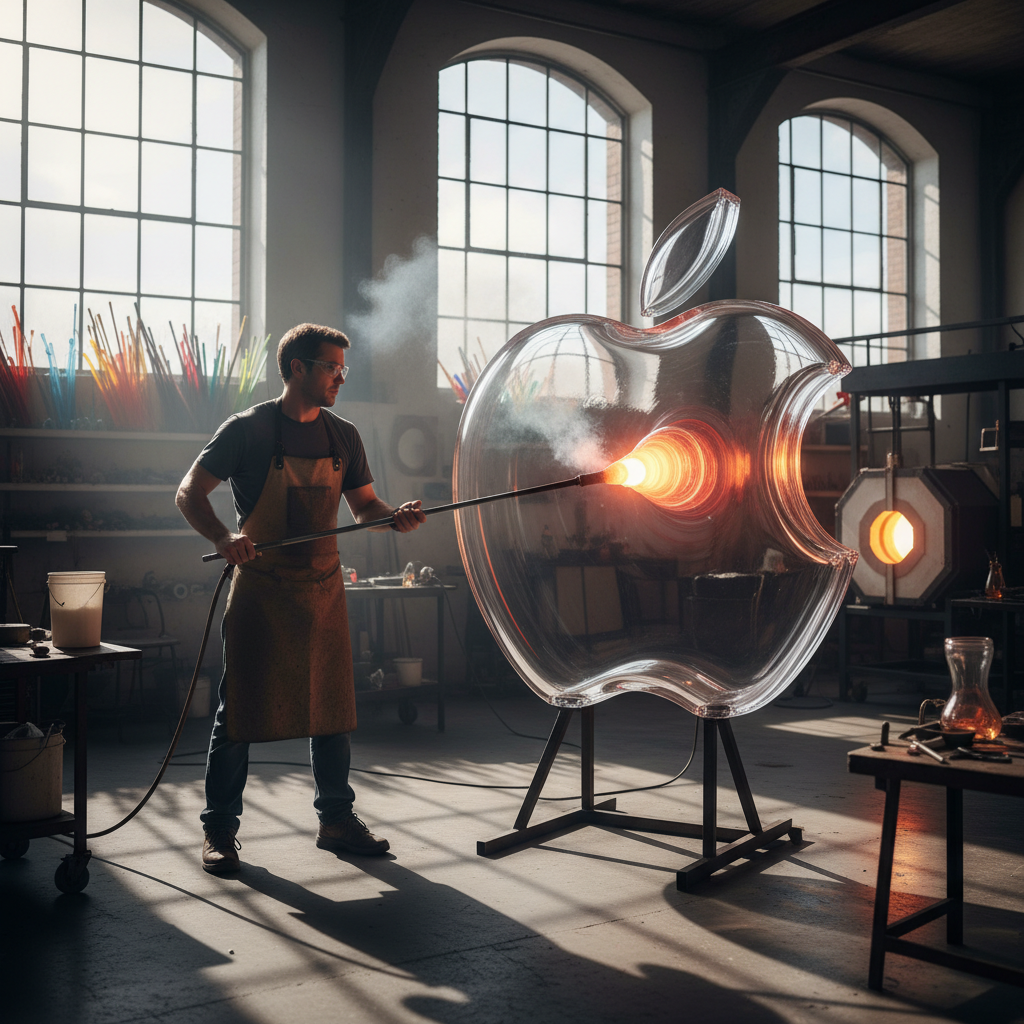
Apple CEO Tim Cook said the statue was made by Corning, a 145-year-old glass company and longtime Apple partner that makes specialty glass for iPhone displays. The work was sculpted by a former corporal in the U.S. Marine Corps who now works in glass art at Apple. The final product was a giant circle of glass, cut and sanded down to reveal a giant Apple logo in the center. “This actually comes from Utah,” Cook said. “A 24 karat gold base, engraved with President Trump’s name.” Cook then added the cherry on top: a hand-signed note that read “Made in America.”
For a president who has been goading companies to manufacture their goods in the U.S., the symbolism seemed to land with Trump. In the Oval Office, where Cook was presenting the gift, the president confirmed that Apple — and any other company building factories in the U.S. — will be subject to “no charge” when tariffs on semiconductors officially go into place. The exemption is welcome relief for Apple, which has been subjected to months of Trump’s trade war bark but had also been in the president’s crosshairs over where its supply chain is located.
Wednesday’s announcement follows a difficult spring for the company. Trump has gone on the attack, lambasting Apple for moving portions of its iPhone manufacturing to India instead of the U.S. “Under my tariff policy,” Trump declared in April, “we will have ‘Made in America’ iPhones. Perhaps even bigger than we have ever made.” In May, as it became clearer that Apple had no plans to move iPhones to the U.S., the criticism was more explicit. Trump commented publicly that he had “a little problem with Tim Cook” as he was traveling in the Middle East. In another conversation, according to a report from the New York Times, Trump vented to Cook directly. “We are treating you really good,” the president said. “We put up with all the plants you built in China for years. We are not interested in you building in India.”
Analysts have long said that assembling iPhones in the U.S. is a complicated process that could take years — if it’s even possible. But Trump’s team went full steam ahead with a narrative that the effort was within reach. Commerce Secretary Howard Lutnick told CNBC that Apple had spoken of “robotic arms” to meet the kind of assembly precision that it achieves with its China-based factories.
Cook, in other words, has not given in. But Wednesday’s announcement suggests Trump may have tempered his demands. Whereas Trump previously had been threatening a 25 percent tariff on Apple if it didn’t assemble iPhones domestically, he now says Apple has taken “a significant step toward the ultimate goal of ensuring that iPhones sold in America also are made in America.” He has backed away, for now, from threatening immediate action.
Cook has said that some iPhone components — semiconductors, glass, Face ID modules — are already made in the U.S. But he’s given no definitive timeline for when full assembly might come to the U.S., and he has made clear it will be a while. “Right now, the iPhone will be manufactured overseas for a while,” Cook said Wednesday.
Apple has played this song and dance before. Throughout Trump’s first term, Cook often mollified the president with a promise of more investment in the U.S., while taking a pass on his more forceful demands. In 2017, for instance, Trump claimed that Apple would be building three “big, beautiful” new plants in America. One plant opened the following year — but it produced face masks, not iPhones. In 2019, Trump toured another plant in Texas that he claimed would produce iPhones. Apple instead dedicated the plant to MacBook Pro manufacturing.
Apple said Wednesday that it will now invest a total of $600 billion in the U.S. over the next four years. It’s a big number, but analysts told Reuters that it was in line with Apple’s spending history and previous commitments under both the Biden administration and Trump’s previous term. In other words, Apple may not be offering anything new.
Trump has threatened that companies that fail to deliver on such commitments will be subject to retroactive tariffs. But as things stand, Apple is on track to continue its typical investment pace, while keeping final iPhone assembly in other countries. The tariff calculus, as far as Apple is concerned, has not shifted. And Trump has decided not to force the issue, at least for now.